Approximately 410 kilometers southwest of mainland Okinawa, just 10 minutes by high-speed boat from Ishigaki Port, Taketomi Island offers the closest yet most profound time-travel experience in the Yaeyama archipelago. This flat coral reef island of 9.11 km² with a circumference of roughly 9 kilometers is home to approximately 360 residents. Its village, designated a National Important Preservation District for Groups of Traditional Buildings in 1987, preserves red-tile roofs, coral stone walls, white sand lanes, and vibrant bougainvillea exactly as they appeared in the Ryukyu era. Ride a water buffalo cart through the village while listening to sanshin melodies, hold star-shaped sand in your palm, and dip your feet into one of Japan's most transparent beaches — Taketomi is the highlight of any Yaeyama trip and a small gem that holds Okinawa's original landscape.
.jpg)
1. Taketomi Island Overview — Ryukyu Heritage on a Coral Reef
Basic Island Facts
Taketomi Island sits approximately 6 kilometers southwest of Ishigaki, about 10 minutes by high-speed boat. With an area of 9.11 km² and a maximum elevation of just 21 meters, this extremely flat uplifted coral island can be circled by bicycle in about one hour. The subtropical oceanic climate maintains an annual average temperature of 24°C, staying above 18°C even from December through February. As of the 2020 census, the island has a population of approximately 360, concentrated in three settlements (East, West, and Nakasuji) near the island's center.
History and Culture — Taketomi's Identity
The island's name derives from a 15th-century Ryukyu Kingdom chieftain named Taketomi who governed the island. Islanders have passed down the spirit of "utsugumi" for generations — meaning "working together in unity" — which forms the foundation of village landscape preservation and festival management. In 1986, residents voluntarily established the Taketomi Island Charter, enshrining five principles: "don't sell, don't pollute, don't disturb, protect, and revitalize." This charter remains the legal and cultural foundation for preserving the island's landscape and heritage to this day.
Preservation District and Village Landscape
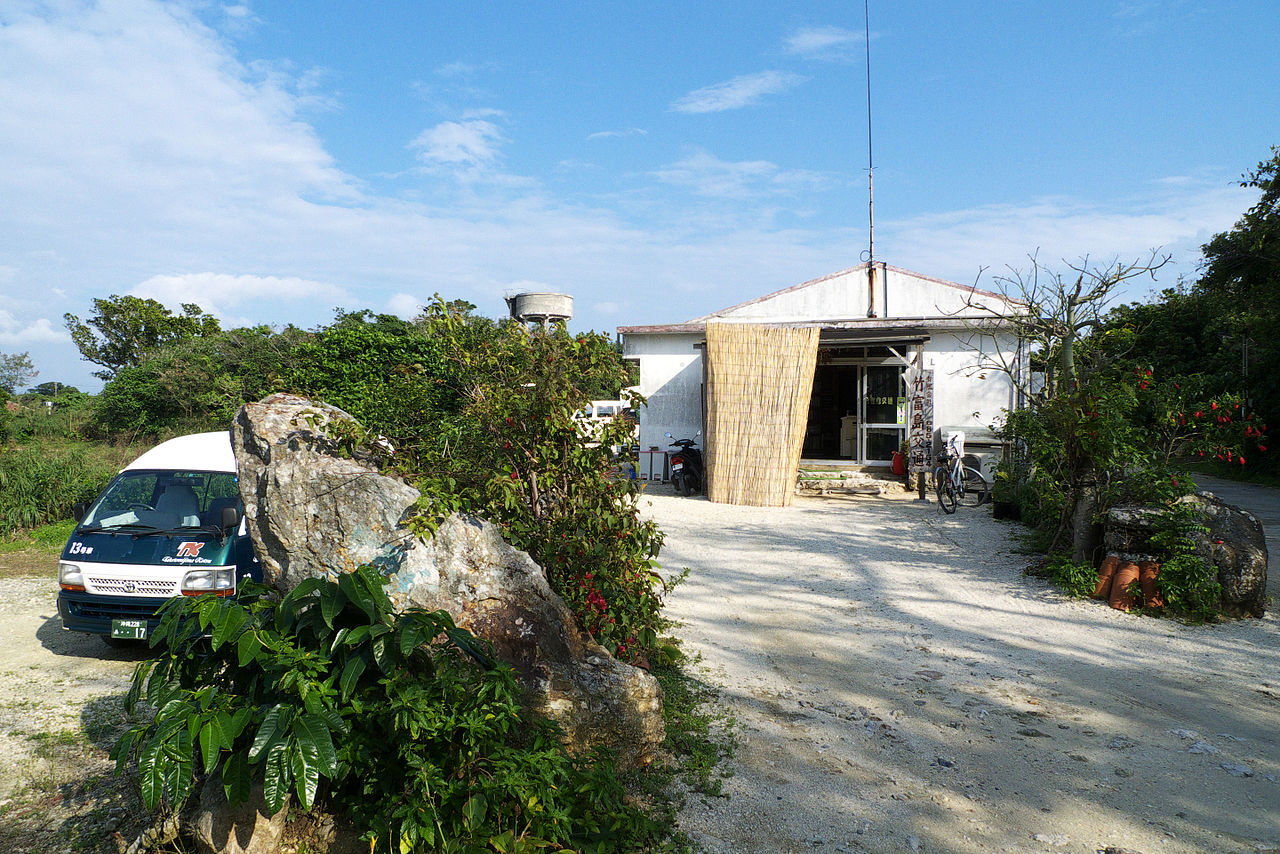
In 1987, Taketomi Island's entire village was designated a National Important Preservation District for Groups of Traditional Buildings — the first in Okinawa Prefecture and one of the earliest designations since the system's creation in 1975. Protected elements include traditional houses with red-tile (akagawara) roofs, coral limestone (Ryukyu limestone) walls, fukugi windbreak trees, and white coral sand lanes. Every morning, residents sweep the sandy lanes with brooms to create decorative patterns — a daily act that is itself a living cultural heritage.
2. Water Buffalo Carts — Taketomi's Signature Experience
What Is a Water Buffalo Cart?
The water buffalo cart (suigyu-sha) is Taketomi Island's ultimate symbol and most popular experience. Board a cart pulled slowly along the village's white sand lanes by a water buffalo weighing approximately 800 kg, while a guide plays sanshin (Okinawan three-stringed instrument) and sings the Yaeyama folk song "Asadoya Yunta." The roughly 25-to-30-minute circuit through the village lets you soak in the scenery of red-tile roofs, shisa guardian lions, and bougainvillea, accompanied by the guide's commentary.
Practical Information
Two operators run the carts: Taketomi Kanko Center and Nitta Kanko. At Taketomi Kanko Center, adult fare is 3,300 yen (3,900 yen during peak season), children 1,650 yen (1,950 yen peak). Operating hours are approximately 9:00-17:00 with departures every 15-20 minutes. A free shuttle from the port takes about 5 minutes. Walk-ins are accepted, but during Golden Week and summer peak season (July-August), 30-minute to 1-hour waits can occur, so early morning visits are recommended.
3. Kondoi Beach — One of Japan's Most Beautiful Beaches
An Endless Emerald Sea
Kondoi Beach, on Taketomi's west coast, is consistently ranked among Japan's most beautiful beaches. Pure white coral sand meets shallow, transparent emerald waters stretching as far as the eye can see. At low tide, a sandbar emerges in the middle of the sea that you can walk across. The extremely shallow depth and calm waves make it perfect for families with children. Water temperatures allow swimming from April through November, exceeding 30°C at the height of summer.
Visitor Information
Free admission. Restrooms and changing facilities available. No food vendors on the beach, so purchase drinks and snacks at village shops beforehand. Approximately 10 minutes by bicycle or 25 minutes on foot from the port. Note: beach umbrellas and tents are prohibited, and some areas lack jellyfish nets, so rashguards are recommended. Facing west, it doubles as a sunset viewing spot.
4. Kaiji Beach — The Secret of Star-Shaped Sand
What Is Star Sand?
Kaiji Beach (Kaiji-hama), also known as "Star Sand Beach (Hoshizuna no Hama)," is a unique beach on Taketomi's southwest coast. Mixed into the sand are star-shaped particles — actually the calcified shells of foraminifera, single-celled organisms. The species, Baculogypsina sphaerulata, measures approximately 1-2 mm. Press your palm gently into the sand and star-shaped grains will stick to it. As this is a national park area, collecting sand is prohibited, but you can purchase bottled star sand at the souvenir shop near the beach entrance.
Important Notes for Kaiji Beach
Due to strong currents and rocky terrain, Kaiji Beach is not suitable for swimming. It's a beach for star-sand hunting and strolling. Just a 10-minute walk south from Kondoi Beach, making it efficient to visit both. Benches under shady trees provide pleasant rest spots.
5. Nishi Pier — Sunset from a Registered Cultural Property
A Historical Pier
Nishi Pier (Nishi-sanbashi) is a concrete pier extending approximately 105 meters from Taketomi's west coast. Built in 1938, it originally served as a berth for agricultural boats and as the departure point for islanders commuting to rice paddies on Ishigaki Island. Though no longer functioning as a pier, it was designated a National Registered Tangible Cultural Property in 2005 and is preserved as a structure that testifies to Taketomi's history.
Taketomi's Premier Sunset Spot
Extending straight westward, Nishi Pier is Taketomi Island's most famous sunset location. Standing at the pier's end, nothing obstructs the view as the sun sinks into the horizon. In summer, it drops into the open sea; in winter, it silhouettes behind Iriomote Island with dramatically shifting colors. Approximately 5 minutes by bicycle or 15 minutes on foot from the village.
6. Nagomi Tower — A Panoramic Village View
Red-Tile Panorama from the Observation Deck
Nagomi Tower (Nagomi no To) is a concrete observation tower approximately 4.5 meters tall built in 1953 atop a small hill in the village center. From the top, a 360-degree panorama reveals Taketomi's red-tile roofs scattered among blue skies and greenery — the island's most iconic image. Currently, the tower itself is closed for climbing due to deterioration, but the adjacent observation deck (Akayama Observatory) offers the same views safely. Free admission, centrally located with easy access.
7. Taketomi Minsa Weaving — A Textile That Says "Together Forever"
The 5-and-4 Pattern
Taketomi Minsa weaving is a traditional textile of the Yaeyama region with a particularly long history on Taketomi Island. Its most distinctive feature is the pattern of 5 and 4 square motifs (kasuri design) at the center of the sash. "5 (itsu)" means "always (itsu no)," and "4 (yo)" means "world/lifetime (yo)" — together forming "itsu no yo made mo" (together forever), a pledge of eternal love. Traditionally, women wove and gifted these sashes to the men they wished to marry.
Workshops and Souvenirs
At the Minsa Craft Center on Taketomi Island, visitors can observe the weaving process or try making a coaster (approximately 2,000-3,000 yen, 30-60 minutes). Coasters, cup saucers, wallets, and bags featuring the Minsa pattern are quintessential Taketomi souvenirs. The Minsa Craft Center main store in Ishigaki City also carries these products.
8. Access & Practical Guide
Getting from Ishigaki to Taketomi
Two ferry companies — Anei Kanko and Yaeyama Kanko Ferry — operate from Euglena離島 Terminal at Ishigaki Port. Travel time is approximately 10-15 minutes; one-way fare 880 yen, round-trip 1,700 yen (2026 rates). With over 20 daily departures at roughly 30-minute intervals, service is extremely convenient. The 3-day Island Hopping Pass (5,800 yen) covers not only Taketomi but also Iriomote, Kohama, and Kuroshima.
Getting Around the Island
Taketomi is flat and small, making bicycles the most efficient transportation. Several rental shops near the port charge approximately 300 yen/hour or 1,500 yen/day. Cycling around the island takes about one hour; covering just the main sights requires roughly 2-3 hours. There are no rental cars or taxis. Water buffalo cart operators and some accommodations offer free shuttle service from the port.
Suggested Itineraries
Half-day (3-4 hours): Water buffalo cart, Nagomi observation deck, Kaiji Beach (star sand), Kondoi Beach. Full day (6-7 hours): Water buffalo cart, Nagomi Tower, Minsa Craft Center, lunch (soba), Kondoi Beach (swimming), Kaiji Beach, Nishi Pier (sunset). To catch the sunset, check the last ferry (around 18:00) and consider an overnight stay on Taketomi. Guesthouse room-only rates run approximately 4,000-6,000 yen; with two meals, about 8,000-12,000 yen.
Frequently Asked Questions
Q. Is a day trip to Taketomi Island enough?
A. A half day (3-4 hours) is enough to cover the main attractions including the water buffalo cart, Kaiji Beach, and Kondoi Beach, making a day trip feasible. However, seeing the sunset at Nishi Pier requires a full day, and to enjoy the starry skies and the quiet village atmosphere at night, an overnight stay is highly recommended.
Q. Can you snorkel at Kondoi Beach?
A. Kondoi Beach is very shallow with a sandy bottom, making it better suited for swimming and strolling than snorkeling. For coral reef snorkeling, try Yonehara Beach on Ishigaki or the Kerama Islands.
Q. Do I need to book the water buffalo cart in advance?
A. Walk-ins are generally accepted, making advance reservations unnecessary. However, during Golden Week (late April to early May) and summer peak season (July-August), waits of 30 minutes to 1 hour can occur. Try visiting early in the morning or right after lunch if possible.
Q. Are there ATMs or convenience stores on Taketomi Island?
A. There are no convenience stores. Shops are extremely limited. One ATM exists at the post office (Taketomi Post Office) with restricted hours. Bring sufficient cash from Ishigaki. Most establishments do not accept card payments.
Q. Can I take star sand home?
A. As Taketomi Island is within a national park, collecting sand, shells, and coral from the beach is prohibited. Bottled star sand is available at the souvenir shop near the Kaiji Beach entrance (200-500 yen).