What Is Awamori — Okinawa's Traditional Distilled Spirit with 600+ Years of History
Awamori (泡盛) is Japan's oldest distilled spirit, produced exclusively in Okinawa Prefecture. Its history stretches back more than 600 years to the 15th century Ryukyu Kingdom era, when distillation techniques brought from Southeast Asia were adapted and developed into a unique Okinawan tradition. It differs fundamentally from standard Japanese shochu in its raw ingredients, production methods, and aging culture — making it an entirely distinct category of spirit.
Awamori has three defining characteristics. First, it uses Thai indica rice (long-grain rice) as its sole raw ingredient. Second, it employs black koji mold (Aspergillus luchuensis), a fungus indigenous to Okinawa, for fermentation. Third, it utilizes a unique method called zen-koji shikomi (全麹仕込み / all-koji fermentation), where the entire batch of rice is converted into koji before fermentation begins. These three elements create awamori's distinctively deep and rich flavor profile.
Several theories exist about the origin of the name. The most widely accepted is that "awa" (泡 = bubbles) + "mori" (盛 = overflowing) refers to the traditional method of checking alcohol content by pouring the spirit from a height and observing the size and persistence of the bubbles. Other theories suggest it derives from "awa" (粟 = millet) or was a name given by the Satsuma domain to distinguish Ryukyuan spirits from their own shochu.
Today, Okinawa is home to 47 awamori distilleries, each producing hundreds of varieties with their own unique character and flavor. As of 2024, annual production is approximately 16,000 kiloliters, with about 30% being kusu (古酒) — aged for 3 years or more.

History of Awamori — From the Ryukyu Kingdom to Modern Day
The history of awamori is inseparable from the history of the Ryukyu Kingdom (琉球王国). During the 14th and 15th centuries, Ryukyu was a maritime trade hub connecting China, Japan, Korea, and Southeast Asia. It was through this trade network that distillation techniques and indica rice were introduced from Siam (present-day Thailand).
| Era | Period | Key Events in Awamori History |
|---|---|---|
| Early Ryukyu Kingdom | 1429–1609 | Distillation techniques arrive from Siam (Thailand). Production begins under royal supervision. Manufacturing permitted only in 3 districts near Shuri Castle: Akada, Sakiyama, and Torihori |
| Post-Satsuma Invasion | 1609–1879 | Production continues under Satsuma clan oversight. Awamori served as tribute goods to China and Japan. Strict quality control by the royal government |
| Ryukyu Disposition | 1879–1945 | Production liberalized after incorporation into Japan. Expansion beyond the Shuri districts. Private distilleries established during the Meiji period |
| World War II | 1945 | The Battle of Okinawa destroys most distilleries and aging vessels. Ancient kusu aged over 100 years is lost forever — a cultural tragedy |
| U.S. Administration | 1945–1972 | Postwar reconstruction of distilleries begins. Some demand from U.S. military bases. Full-scale rebuilding from 1949 |
| Post-Reversion | 1972–Present | Japanese liquor tax law applied. Recognition grows nationwide and internationally alongside tourism. 2023 UNESCO Intangible Cultural Heritage nomination pursued |
The 1945 Battle of Okinawa stands as the most tragic event in awamori's history. Before the war, multiple distilleries possessed kusu aged 100 or even 200 years, but bombardment and fires destroyed virtually everything. The oldest kusu in Okinawa today dates from postwar production, making it roughly 70–80 years old. This loss is remembered by Okinawan people not merely as material destruction but as the irretrievable loss of cultural heritage.
The three historic Shuri brewing districts were the center of awamori production throughout the Ryukyu Kingdom era. The royal government restricted manufacturing to these three areas to maintain quality control, and the awamori produced here served as gifts to the royal court and for entertaining Chinese envoys (sapposhi). This tradition continues today, with distilleries like Zuisen (瑞泉) and others in the Shuri area maintaining their prestigious heritage.
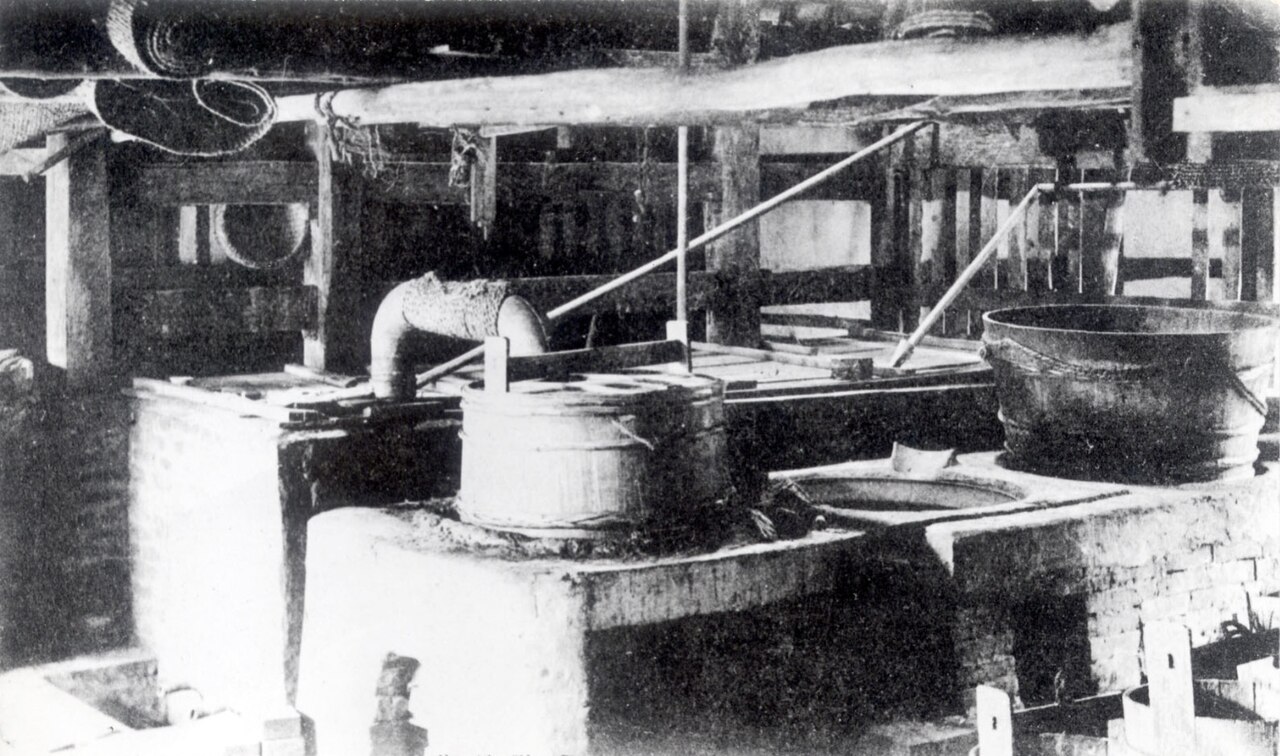
The Production Process — The Science of Black Koji and Indica Rice
Awamori's production process differs fundamentally from Japanese shochu and other distilled spirits. The most critical difference is zen-koji shikomi (全麹仕込み / all-koji preparation). While standard shochu mixes koji with steamed grains, awamori converts the entire batch of raw rice into koji before fermentation.
Detailed Production Steps
| Step | Description | Duration | Key Point |
|---|---|---|---|
| 1. Rice Washing | Thai indica rice is thoroughly cleaned | ~30 min | Indica rice's long, slender grains allow black koji mycelium to penetrate efficiently |
| 2. Soaking | Washed rice is soaked to absorb moisture | ~1 hour | Proper moisture content determines koji quality |
| 3. Steaming | Rice is steamed at high temperature | ~40–60 min | Gelatinizes starch and sterilizes against unwanted bacteria |
| 4. Koji Making | Black koji spores are sprinkled over steamed rice and cultivated | ~40–48 hours | The most crucial step. Temperature and humidity must be carefully managed. Citric acid production prevents contamination |
| 5. Fermentation Setup | Water and yeast are added to the koji to begin fermentation | Immediate | All-koji — the entire rice has been converted to koji before fermentation begins |
| 6. Fermentation | The moromi (mash) ferments for approximately 2 weeks | ~14–18 days | Alcohol fermentation + flavor compound generation. Final alcohol reaches ~17–18% |
| 7. Distillation | Single distillation using pot stills | ~6–8 hours | Atmospheric pressure distillation is traditional; vacuum distillation yields a lighter flavor |
| 8. Aging | Stored in clay pots, tanks, or oak barrels | Months to decades | Aging for 3+ years earns the designation kusu (古酒) |
The Secret of Black Koji Mold
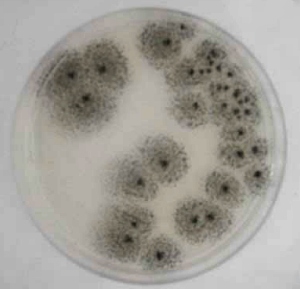
Black koji mold (Aspergillus luchuensis) is the most essential element in awamori production. Originally discovered in Okinawa's natural environment, this mold possesses two critical characteristics.
- Powerful citric acid production: During fermentation, it generates large amounts of citric acid, lowering the moromi's pH and preventing contamination by unwanted bacteria — even in subtropical climates. This was nature's gift that made safe alcohol production possible in an era without refrigeration.
- Unique flavor compound generation: Black koji produces vanillin, 4-vinylguaiacol, and other aromatic compounds during fermentation, creating awamori's distinctive sweet, rich aroma.
In 2006, research by the Brewing Society of Japan led to the reclassification of black koji from Aspergillus awamori to the independent species Aspergillus luchuensis. The scientific name meaning "koji of Ryukyu" formally recognized this mold as indigenous to Okinawa.
Why Thai Indica Rice?
The use of Thai indica rice in awamori has both historical and scientific reasons. Historically, it arrived through Ryukyu Kingdom trade with Siam (Thailand). Scientifically, the long, slender shape of indica rice grains is optimal for black koji mycelium to penetrate deeply into the rice interior. Additionally, indica rice has a harder starch structure than japonica rice, resulting in fewer off-flavors during distillation and a cleaner taste.
The indica rice currently used is primarily Thai broken rice (砕米) — rice fragments produced during the milling of food-grade Thai rice. This offers cost benefits while also allowing faster koji mycelium penetration due to the smaller grain size.
Kusu (Ancient Aged Spirit) Culture — Deep Flavor Created by Time
No discussion of awamori is complete without kusu (クース / 古酒) culture. Kusu refers to awamori aged for 3 years or more, an officially recognized designation under Okinawan liquor regulations. The longer it ages, the smoother the taste and deeper the aroma becomes, developing complex flavors comparable to fine whisky or brandy.
The Science of Kusu Aging
The chemical changes that occur during awamori aging are remarkably complex. The main transformations include:
- Ester formation: Alcohols react with organic acids to produce fruity and floral ester compounds. Notably, ethyl caprylate increases, bringing tropical fruit aromas reminiscent of banana and pineapple.
- Free fatty acid reduction: The harsh, oily odors prominent in young awamori gradually diminish over time, resulting in a smoother profile.
- Vanillin increase: Particularly in oak barrel aging, vanillin leaches from the wood, adding sweet vanilla notes.
- 1-octen-3-ol decrease: The component responsible for awamori's characteristic "young" smell diminishes, creating a cleaner profile.
Aging Vessel Characteristics
| Vessel Type | Features | Flavor/Aroma Impact | Notable Distilleries Using |
|---|---|---|---|
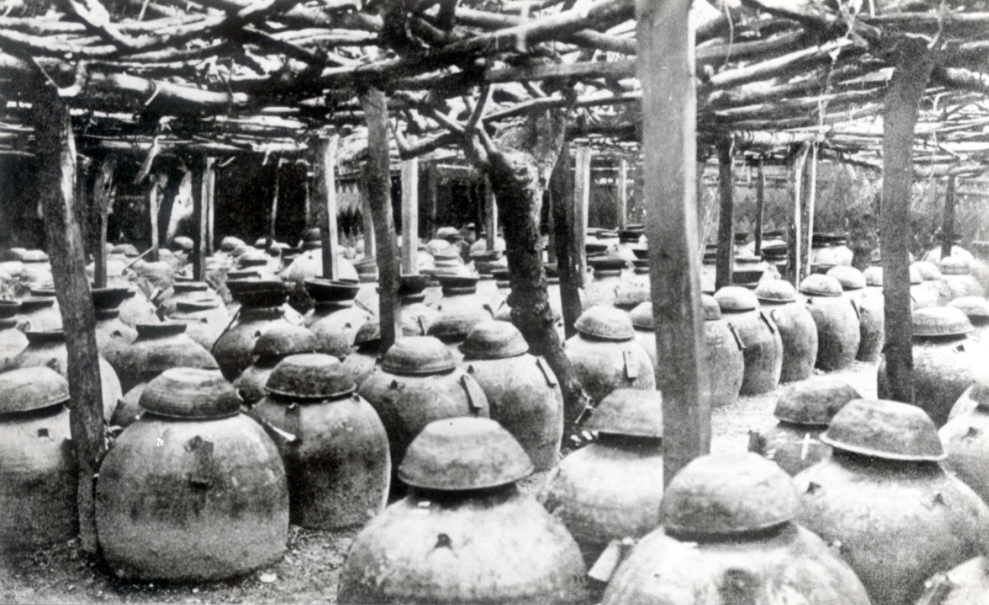
| Kame (Clay Pot / 甕) | Traditional ceramic vessels with microscopic pores that allow the spirit to breathe | Smooth, rounded flavor. The classic kusu standard | Zuisen, Kumesen |
| Stainless Steel Tank | Large-capacity aging with easy temperature control | Clean, pure taste preserving raw ingredient character | Zanpa, Kumejima no Kumesen |
| Oak Barrel | Borrowed from whisky aging traditions. Wood compounds dissolve into spirit | Vanilla and caramel notes. Amber coloring | Helios, Masahiro |
| Shigaraki-yaki | Traditional Japanese pottery with unique texture | Silky mouthfeel with mineral nuances | Select limited editions |
Shitsugi — The Tradition of Growing Kusu at Home
Okinawa has a unique kusu aging tradition called shitsugi (仕次ぎ). This involves arranging multiple clay pots in order of size at home. When spirit is drawn from the oldest (first) pot for drinking, it is replenished from the second pot into the first, the third into the second, and so on. Fresh awamori is added to the last pot.
This system is remarkably similar to the Spanish solera system used for sherry, where the blending of old and new spirits means the average age continuously increases over time. During the Ryukyu Kingdom era, it was customary to prepare a clay pot when a child was born and begin aging awamori, then open it for the child's wedding or coming-of-age celebration. Sharing kusu aged 20–25 years at such celebrations was one of the greatest joys for Okinawan families.
Many Okinawan families continue the shitsugi tradition today, and distilleries sell "My Kusu Making" kits so tourists can experience the tradition. Generally, a 1–3 liter ceramic pot filled with awamori and stored in a cool, dark place is all you need to begin aging kusu at home.
Major Distillery Comparison — Guide to Okinawa's 47 Distilleries
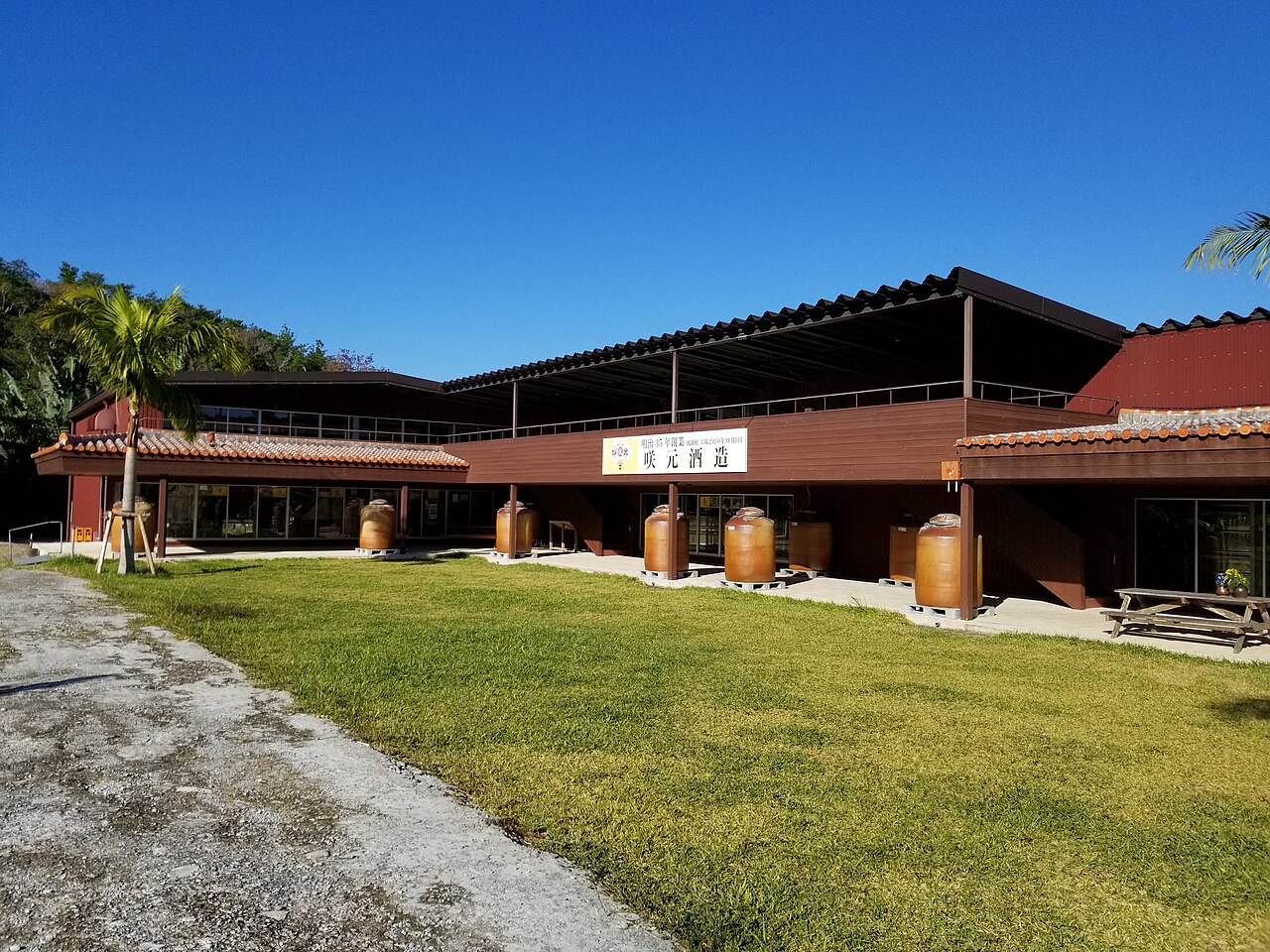
Okinawa's 47 awamori distilleries span from the main island to the outer islands of Miyako and Ishigaki, each reflecting local character and terroir. Here are the most notable distilleries for visitors.
| Distillery | Location | Founded | Flagship Brand | Distinguishing Features | Tours Available |
|---|---|---|---|---|---|
| Zuisen Shuzo | Naha, Shuri | 1887 | Zuisen, Zuisen Kusu | Historic Shuri district. Traditional kame aging. Royal tribute heritage | Yes (reservation required) |
| Higa Shuzo / Zanpa | Yomitan Village | 1948 | Zanpa, Zanpa Premium | Okinawa's #1 seller. Clean, easy-drinking flavor. Black and White varieties | Yes (free, walk-in) |
| Kumesen Shuzo | Naha City | 1952 | Kumesen, Kumesen Kusu | #1 nationwide shipment volume. Great for beginners. Excellent value | Yes (reservation required) |
| Seifuku Shuzo | Ishigaki City | 1949 | Seifuku, Jikabi Seifuku | Ishigaki Island's signature. Direct-fire distillation for rich depth. Yaeyama style | Yes (free, walk-in) |
| Helios Shuzo | Nago City | 1961 | Kura, Nushi | Pioneer of oak barrel aging. Whisky-like character. Also produces beer and rum | Yes (free, walk-in) |
| Masahiro Shuzo | Itoman City | 1883 | Masahiro, Shima | One of Okinawa's oldest distilleries. Diverse aging experiments | Yes (free, walk-in) |
| Kumejima no Kumesen | Kumejima Island | 1949 | Kumejima no Kumesen | Uses Kumejima deep-sea water. Mineral-rich and exceptionally smooth | Yes (reservation required) |
| Mizuho Shuzo | Naha City | 1848 | Mizuho, Ender | 175+ year history. Innovative flavored awamori including coffee varieties | Yes (reservation required) |
| Taragawa Shuzo | Miyakojima | 1948 | Taragawa, Ryukyu Otohime | Miyako Island's flagship. Natural cave storage for aging. Popular tours | Yes (free, walk-in) |
| Sakimoto Shuzo | Yonaguni Island | 1927 | Yonaguni, Hanazake | Japan's westernmost distillery. 60-proof Hanazake is the strongest spirit in Japan | Yes (reservation required) |
Particularly noteworthy is Hanazake from Yonaguni Island. At 60% ABV, it is the highest-proof spirit commercially available in Japan. Technically classified as "spirits" rather than awamori under Japanese liquor tax law, it is uniquely permitted to be produced only on Yonaguni Island. The name "hana" (花 = flower/first) refers to the first distillate that comes off the still, bottled undiluted. It is traditionally used in ceremonies and celebrations.
How to Drink Awamori — 7 Ways to Enjoy It
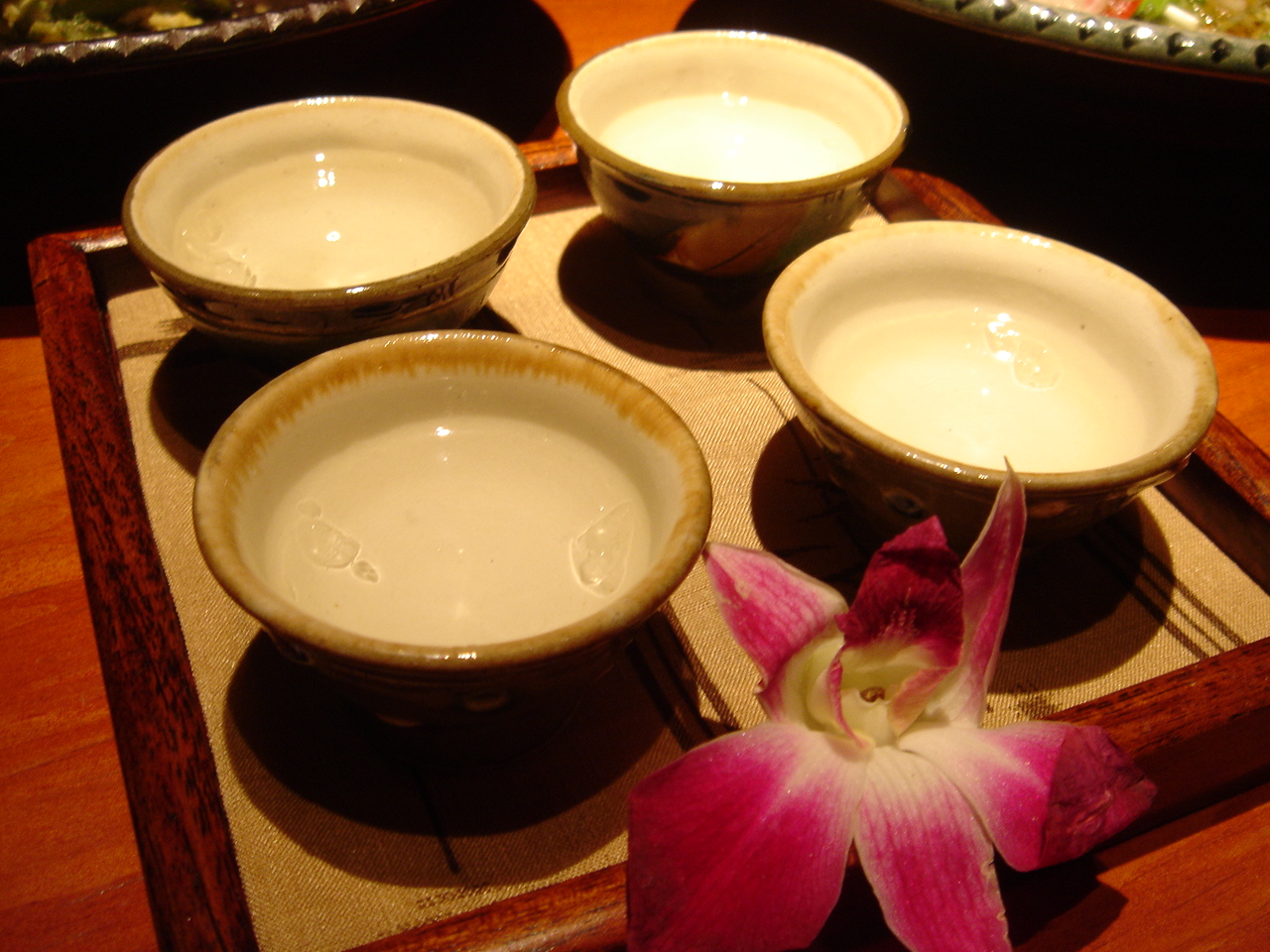
Awamori is a remarkably versatile spirit. While its alcohol content ranges from 25–30% (standard) to 35–43% (kusu), different serving methods create entirely different tasting experiences.
| Serving Method | Recommended Awamori | Ratio/Temperature | Character | Best Season |
|---|---|---|---|---|
| Straight (Neat) | Kusu, 35%+ ABV | Room temperature or slightly chilled | Full appreciation of kusu's deep aroma and flavor. For experienced drinkers | Year-round |
| On the Rocks | Kusu, 30–35% ABV | 1–2 large ice cubes | Flavor evolves as ice melts. The most popular method | Summer |
| Mizuwari (With Water) | Standard, 25–30% ABV | Awamori:Water = 3:7 to 5:5 | Mellowed and food-friendly. Best for beginners | Year-round |
| Soda Highball | Standard, 25–30% ABV | Awamori:Soda = 3:7 | Refreshing effervescence. Add shikuwasa citrus for an Okinawan twist | Summer |
| Oyuwari (Hot Water) | Standard, 30% ABV | Awamori:Hot Water = 4:6, ~70C | Releases aromatics beautifully. Perfect for cooler weather | Winter |
| Cocktails | Standard, 25–30% ABV | Various combinations | Shikuwasa + soda, pineapple juice, tonic water, and more | Year-round |
| Kan (Warmed) | Kusu, 35%+ ABV | Warmed to ~40C in a karakara vessel | Traditional method. Enriches aroma and smooths the palate | Winter |
Food Pairing Guide
Awamori pairs exceptionally well with Okinawan cuisine but is also surprisingly adaptable to many other dishes.
- Pork dishes: Rafute (braised pork belly), soki soba — awamori's ability to cut through richness balances the fattiness of pork perfectly
- Tofu dishes: Jimami tofu (peanut tofu), tofu-yo — tofu-yo, a fermented tofu made with awamori, is considered the ultimate accompaniment
- Seafood: Sea grapes (umi-budo), sashimi — pair with mizuwari or soda for a lighter pairing
- Champuru: Goya champuru, tofu champuru — awamori soda highball makes a fantastic combination
- Western cuisine: Blue cheese, dark chocolate — aged kusu's complexity creates surprisingly good matches
- Desserts: Sata andagi (Okinawan doughnuts), chinsuko — enjoy alongside sweet Okinawan confections
Traditional Drinking Vessels
Okinawa's traditional drinkware enriches the awamori experience considerably.
- Karakara: A traditional Okinawan serving flask with a flat shape. A small stone or ceramic ball inside creates a "kara-kara" rattling sound when the vessel is empty — hence the name
- Chibugara: A small drinking cup used with the karakara
- Dachibun: A hip flask traditionally carried at the waist. Its distinctive half-moon shape made it easy to carry while traveling
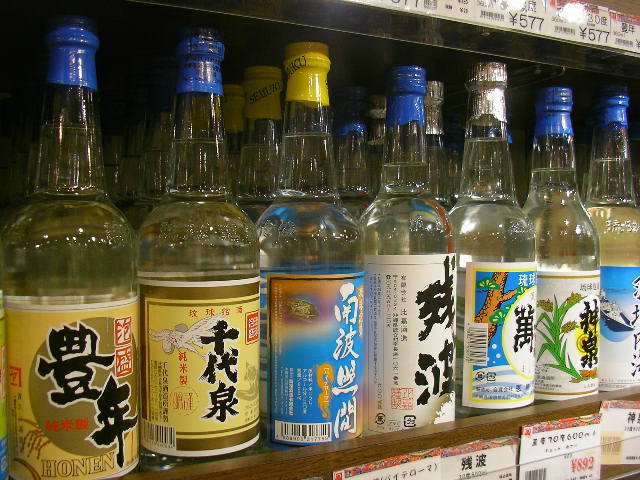
How to Read Awamori Labels — A Smart Consumer's Guide
Awamori labels contain vital information. Learning to read them will greatly help you find the perfect bottle for your tastes.
Essential Label Information
| Label Term | Meaning | Selection Guide |
|---|---|---|
| Alcohol % | Standard: 25–30%, Kusu: 35–43% | Beginners: start at 25%. For mizuwari, 30% is ideal |
| Kusu (古酒) | Aged 3+ years | Check if it's 100% kusu or a blend |
| Kusu ○-nen | Years of aging stated | Available in 5, 7, 10, 15, 20, 25+ year designations |
| Kusu Blend | Mix of kusu and young awamori | 51%+ must be kusu to use the "kusu" label (2015 rule change) |
| Zenryo Kusu (全量古酒) | 100% aged awamori | Top tier. Higher price, but dramatically different quality |
| Joatsu Joryu (常圧蒸留) | Atmospheric pressure distillation | Full-bodied, rich flavor. For traditionalists |
| Genatsu Joryu (減圧蒸留) | Vacuum distillation | Light, clean flavor. Popular with beginners |
| Kame Chozo (甕貯蔵) | Aged in traditional clay pots | Smooth, rounded flavor. The essence of traditional kusu |
| Taru Chozo (樽貯蔵) | Aged in oak barrels | Vanilla and caramel notes. Recommended for whisky lovers |
The 2015 Kusu Labeling Reform
In August 2015, the Okinawa Distillers' Association significantly reformed kusu labeling regulations. Previously, producers could label a blend with the age of the oldest component. Under the new rules, at least 51% of the blend must meet the stated age to carry that designation. Products that are 100% aged awamori can now be labeled "Zenryo Kusu." This reform gives consumers much more accurate information for making purchasing decisions.
Recommendations by Price Range
| Price Range (720ml) | Category | Representative Products |
|---|---|---|
| 800–1,200 yen | Standard awamori, 25–30% | Zanpa White, Kumesen |
| 1,200–2,000 yen | Kusu blend, 3–5 years | Zanpa Black, Zuisen Kusu |
| 2,000–4,000 yen | 100% kusu, 5–10 years | Zuisen 10-Year, Kura 8-Year |
| 4,000–10,000 yen | Premium kusu, 10–20 years | Zuisen 15-Year, Mizuho Zenryo Kusu |
| 10,000+ yen | Ultra-premium kusu, 20+ years | Zuisen 25-Year, Taragawa Cave-Aged 25-Year |
Distillery Tour Guide — Experiencing Awamori Up Close
Visiting an awamori distillery is an essential Okinawa travel experience. Most distilleries offer free tours and tastings, allowing you to witness the production process firsthand and sample freshly made spirits.
Top 5 Distilleries for Visitors
| Rank | Distillery | Location | Hours | Tasting | Admission | Reservation | Highlights |
|---|---|---|---|---|---|---|---|
| 1 | Zuisen Shuzo | Naha, Shuri | 09:00–17:30 | Free, 5 types | Free | Required | Near Shuri Castle. Traditional kame cellar tour. Limited kusu available for purchase |
| 2 | Higa Shuzo (Zanpa) | Yomitan Village | 09:00–17:00 | Free, 3 types | Free | Not needed | Large-scale facility. Combine with Cape Zanpa sightseeing. Well-stocked gift shop |
| 3 | Helios Shuzo | Nago City | 09:00–17:00 | Free, 4 types | Free | Not needed | Multi-spirit brewery (awamori + beer + rum). Impressive oak barrel warehouse |
| 4 | Taragawa Shuzo | Miyakojima | 09:00–17:00 | Free, 3 types | Free | Not needed | Natural limestone cave storage is breathtaking. A Miyako Island must-visit |
| 5 | Seifuku Shuzo | Ishigaki City | 09:00–17:00 | Free, 4 types | Free | Not needed | Ishigaki's flagship distillery. Direct-fire distillation process visible. Limited editions |
Tips for Distillery Visits
- Designated driver alert: Drink-driving is strictly prohibited. Appoint a designated driver or use taxis/buses. Non-drinking visitors receive complimentary soft drinks
- Distillery exclusives: Many distilleries sell limited-edition labels unavailable elsewhere. Kusu exclusives are especially popular
- Photography: Most distilleries permit photos, but the koji room may be off-limits for hygiene reasons
- Languages: Major distilleries have English pamphlets. Some also offer Korean and Chinese guides
- Time needed: Tour takes about 30–60 minutes; including tasting and shopping, allow 60–90 minutes
Buying Guide — Where to Purchase
| Location | Advantages | Disadvantages | Best For |
|---|---|---|---|
| Distillery Direct | Exclusive labels, taste before buying, freshest stock | Limited accessibility and selection | Distillery-exclusive kusu and limited labels |
| Kokusai Street Specialty Shops | Wide brand selection, tasting available | Tourist pricing (slightly higher) | Gift sets, small bottles |
| Naha Airport Duty-Free | Tax-free savings, last chance to buy | Limited selection | Premium kusu, limited editions |
| Supermarkets (AEON, MaxValu) | Lowest prices, local pricing | No tasting, no rare items | Everyday awamori (Zanpa, Kumesen) |
| Makishi Public Market | Great atmosphere, authentic local feel | Harder to compare prices | Mini bottle sets, karakara vessel sets |

Awamori vs Shochu — What's the Difference?
While both are Japanese distilled spirits, awamori and mainland shochu differ fundamentally in ingredients, production, and culture. Here is a clear breakdown of these commonly confused beverages.
| Comparison | Awamori | Mainland Shochu |
|---|---|---|
| Raw Material | Thai indica rice (long-grain) | Barley, sweet potato, rice, buckwheat, etc. |
| Koji | Black koji only | White koji, yellow koji also used |
| Fermentation | All-koji | Two-stage fermentation |
| Distillation | Primarily atmospheric pressure | Both atmospheric and vacuum |
| Aging Culture | Kusu — 3 to 25+ years | Some aged products, but not the mainstream |
| ABV | 25–43% (Hanazake: 60%) | 20–25% is standard |
| History | ~600 years (Ryukyu Kingdom) | ~500 years (16th century onward) |
| Origin | Okinawa Prefecture exclusively | Nationwide (especially Kyushu) |
| Aging Vessels | Kame (clay), tanks, oak barrels | Primarily tanks |
| Traditional Vessels | Karakara, dachibun | No specific traditional vessels |
In summary, awamori is the only distilled spirit in the world made exclusively in Okinawa, with black koji and indica rice, using all-koji fermentation. It is not a type of shochu — it is a distinct spirit with an even older history.
Health and Awamori — The Science of Moderate Drinking
Okinawa's status as one of the world's premier longevity regions is well documented, and the tradition of enjoying moderate amounts of awamori is sometimes cited as a contributing factor. This applies, of course, only to moderate consumption.
Nutritional Characteristics of Awamori
- Zero sugar: As a distilled spirit, awamori contains virtually no sugar or purines. Calorie-for-calorie of alcohol, it is healthier than beer or wine
- Residual citric acid: Trace amounts of citric acid from black koji fermentation remain, traditionally believed to aid fatigue recovery
- Fibrinolytic activity: A 2002 University of the Ryukyus study found that awamori exhibits blood-clot-dissolving enzyme activity — though only at moderate consumption levels
- Calories: Approximately 206 kcal per 100ml (at 30% ABV). Mizuwari (3:7 dilution) brings this to about 60–70 kcal per serving
Moderate Drinking Guidelines
| Serving Method | Daily Guideline | Pure Alcohol | Calories |
|---|---|---|---|
| Straight (30% ABV) | ~80ml | ~20g | ~165 kcal |
| On the Rocks (30%) | ~80ml | ~20g | ~165 kcal |
| Mizuwari (3:7, 30%) | ~270ml (80ml awamori) | ~20g | ~165 kcal |
| Soda Highball (3:7, 25%) | ~320ml (95ml awamori) | ~20g | ~155 kcal |
WHO guidelines recommend approximately 20g of pure alcohol daily for adult men and 10g for women. For 30% ABV awamori, this translates to about 80ml for men and 40ml for women. Okinawa's centenarians were known for their habit of enjoying small amounts over a long time — a philosophy worth emulating.

FAQ
Q. Is awamori the same as shochu?
A. No. While both are distilled spirits, they differ in raw ingredients (indica rice), koji (black koji), and fermentation method (all-koji). Awamori has a history roughly 100 years older than shochu, and its kusu aging tradition is unique to awamori. They are classified differently under Japanese liquor tax law.
Q. What do you recommend for an awamori beginner?
A. Start with Zanpa White (25% ABV) or Kumesen (25% ABV) served as mizuwari (awamori:water = 3:7). These offer a clean, approachable introduction to awamori. Adding a wedge of shikuwasa citrus makes it even more refreshing.
Q. How should I choose my first kusu?
A. Begin with a 5-year kusu on the rocks. Zuisen Kusu 5-Year and Zanpa Black are excellent entry-level options. Look for the "Zenryo Kusu" label to guarantee 100% aged awamori.
Q. Can I bring awamori home from Okinawa?
A. Yes. Check your home country's duty-free alcohol allowances. Naha Airport duty-free shops or in-city duty-free stores make purchasing convenient. Awamori can be packed in checked luggage without proof restrictions, but carry-on liquids are limited to containers of 100ml or less.
Q. Can I age kusu at home?
A. Absolutely. Using the shitsugi method, you can age kusu at home. Purchase a "My Kusu Making" kit from a distillery (ceramic pot + awamori) and store it in a cool, dark place. Periodically drink from the oldest vessel and refill with fresh awamori — the flavor will deepen beautifully over the years.